
Etymology & nomenclature
What is Kathak?
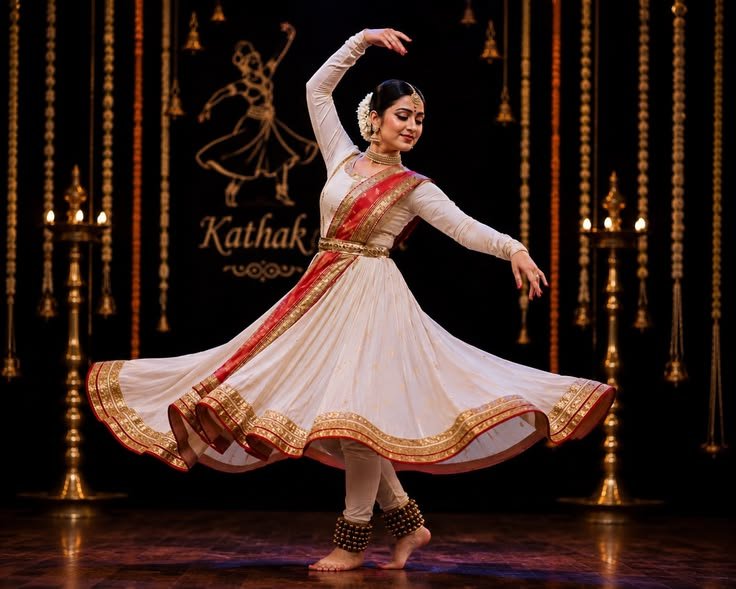
Kathak is one of the eight major classical dance forms of India. The name comes from the Sanskrit katha, meaning "story," and kathakar, "the one who tells a story." Long before it became a codified classical art, Kathak was the craft of wandering bards in North India who narrated scripture and epic through voice, gesture, music and rhythm — performed in village squares and temple courtyards.What sets it apart from India's other classical dance forms is its upright posture, its fast spins called chakkars, its rhythmic footwork known as tatkar, and its close, conversational relationship with the tabla — the dancer's feet and the drummer's hands often trading phrases like two people finishing each other's sentences.
"A Kathak performance moves constantly between two halves of the same instinct: the pure geometry of rhythm, and the human need to tell somebody a story."
Four eras
A history shaped by temples, courts and revival
Kathak did not arrive fully formed — it was reshaped by every world it passed through. Four periods define how it became the form taught today.
15th – 16th century
The Bhakti movement era
Devotional poet-saints turned temple storytelling toward the lives of Krishna and Radha. Kathak absorbed this devotional repertoire, and dance became a vehicle for bhakti — loving, personal devotion — performed as an offering rather than entertainment.
16th – 18th century
The Mughal era
As Kathak moved from temple to royal court, it met Persian court culture. Costumes grew more elaborate, movement more fluid and ornamental, and the dance began to be performed alongside ghazals and instrumental music for a patron audience rather than a congregation.
19th – early 20th century
The British Raj era
Colonial attitudes cast court dancers in a disreputable light, and Kathak — along with other courtly and temple dance traditions — fell into social disrepute and decline, surviving mainly through a small number of hereditary practicing families.
Mid-20th century – present
The post-independence era
After independence, Kathak was deliberately reclaimed as a national classical art. Institutions were founded to teach and codify it, gharana lineages were documented, and Kathak took its place on the concert stage alongside India's other classical forms.
Lineages of style
The gharanas
A gharana is a lineage of teaching — a family or court tradition that shaped its own vocabulary, emphasis and aesthetic within Kathak. Most training today traces back to one of these schools.
01
Lucknow gharana
Nawabi court of Awadh
Prized for grace and subtlety over sheer force. Emphasis falls on abhinaya, fluid body movement and lyrical storytelling, shaped by the refined court culture of Lucknow's nawabs
Legends: Pandit Birju Maharaj, Pandit Shambhu Maharaj
02
Jaipur gharana
Royal court of Jaipur, Rajasthan
Known for vigorous, mathematically precise footwork and powerful, fast chakkars. This school leans into Nritta's technical rigor and rhythmic complexity.
Legends: Pandit Durgalal, Pandita Geetanjali Lal
03
Banaras gharana
Varanasi
Developed a distinct vocabulary of postures and hand movement, with its own approach to composition and rhythm that sets it apart from the Lucknow and Jaipur schools.
Legends: Sitara Devi, Gopi Krishna
04
Raigarh gharana
Princely state of Raigarh
Flourished under royal patronage in the early 20th century, blending Kathak with other Indian musical and dance traditions to produce a distinctive, fusion-influenced repertoire.
Legends: Pandit Kartik Ram, Ramlal Bareth