
Taals
What is Taal?
Taal is the rhythmic framework or time cycle in Hindustani classical music, defined by a fixed number of beats (matras) grouped into sections (vibhags) with specific claps (taali) and a wave (khali) marking its internal structure and the recurring point of resolution (sam).
Commonly used taals in Kathak:
Teentaal (तीन ताल)
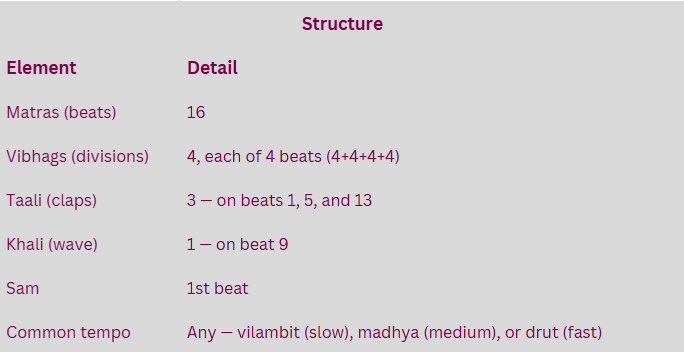
The most common and foundational taal in Hindustani classical music. It has a simple, symmetrical structure, which makes it the taal most students learn first and the one most widely used across khyal, thumri, and instrumental music.
Theka (bol pattern):

The 3rd vibhag ("Dha Tin Tin Ta") is the khali section — played softer, marked with a wave instead of a clap.
Notes: Its name ("teen" = three) comes from the three taali claps in the cycle. Because it's symmetrical and easy to internalize, it's the standard taal for beginner tabla and vocal training, and the most frequent choice in concert performances.
Jhaptaal (झपताल)
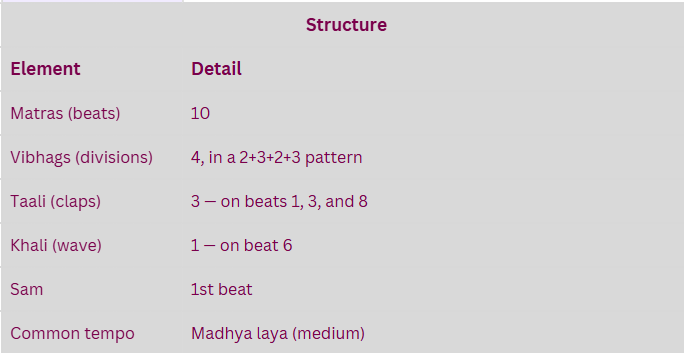
An asymmetrical 10-beat taal, giving it a distinctive lilting, uneven feel compared to Teentaal. Commonly used in madhya laya (medium tempo) khyal and instrumental gats.
Theka (bol pattern):

The 3rd vibhag ("Tin Na") is the khali. Note "Dhi" opens the 1st, 2nd, and 4th vibhags, while "Tin" (a lighter bol) marks the khali section — this bol-based cue makes Jhaptaal's structure easier to follow by ear than some other taals.
Notes: Its uneven 2-3-2-3 grouping is what gives it that distinctive "swing" rather than Teentaal's steady, even feel. It's a favorite for tabla solo performances since the asymmetry gives more room for interesting layakari (rhythmic play).